Three pitches. Three swings. Three home runs, each off a different Dodgers pitcher in Game 6 of the 1977 World Series. On October 18, Reggie Jackson turned Yankee Stadium into the loudest possible proof that the Yankees were champions again. 4
That single night did not erase the season’s friction. It made the friction part of the legend. The Yankees who won in 1977 and 1978 had an owner who demanded urgency, a manager who enforced it, a superstar who invited the spotlight, and a clubhouse full of players unwilling to be background scenery. They were built to win, and they did—but rarely quietly.
More Than a Nickname
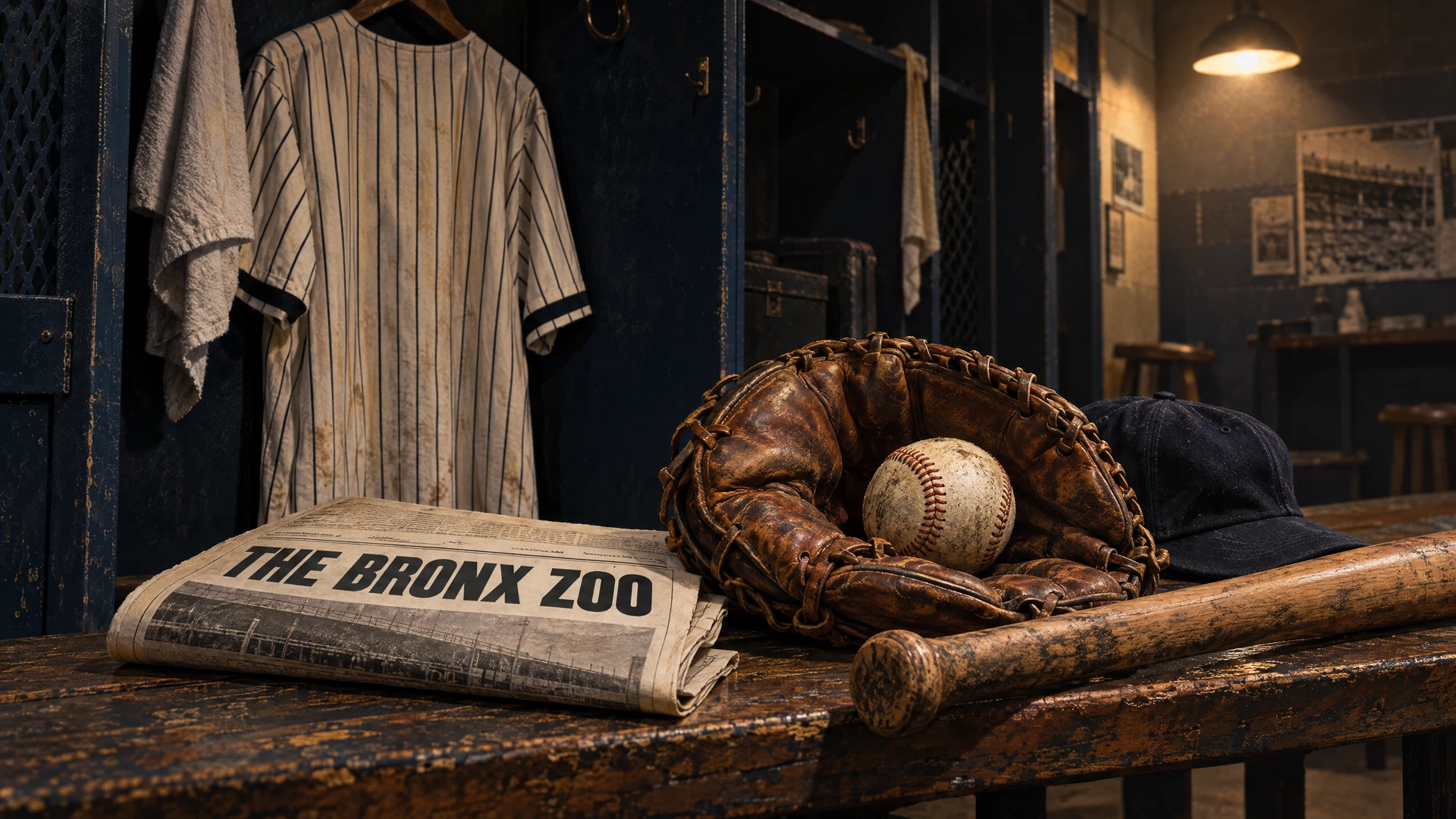
The Bronx Zoo is not a reference to the animal attraction across the borough. In Yankees history, it is the durable shorthand for the late-1970s club: gifted, combustible, relentlessly covered, and capable of turning a routine day at the ballpark into front-page material. The National Baseball Hall of Fame describes the 1970s championship period as the ‘Bronx Zoo’ years, while noting that the Yankees returned to the World Series in 1976 and won titles in 1977 and 1978. 2
Sparky Lyle’s place in that label is essential, but it should be stated precisely. Lyle, the 1977 AL Cy Young Award-winning reliever, worked with writer Peter Golenbock on The Bronx Zoo, published in 1979. SABR describes the book as a best-selling insider view of the sensational and controversial 1978 season. The book gave readers a vivid record of the era’s internal weather; the available evidence does not require the broader claim that it invented the nickname. 5
The phrase endures because it fits the baseball. This was not a team remembered only for a collection of stars or a pair of trophies. It was a team whose public arguments were as conspicuous as its October execution. The point is not that discord magically produced championships. Rather, these Yankees managed to play winning baseball while their differences were impossible to miss.
Steinbrenner, Martin, and Jackson
The conditions for that spectacle were in place before the 1977 opener. A limited partnership headed by George M. Steinbrenner III bought the Yankees from CBS on January 3, 1973. Steinbrenner’s first years as principal owner brought a distinctly restless style of leadership. The Hall of Fame notes the changing managers and front-office figures that marked his early tenure, including Billy Martin’s five turns in the Yankees dugout. 1 2
Martin had taken over for Bill Virdon on August 1, 1975, and had already guided the club back to the 1976 World Series. Then Steinbrenner added free agent Reggie Jackson on November 29, 1976, with a five-year contract. Jackson was a proven October performer arriving in a clubhouse that already had its own leaders, most notably captain Thurman Munson, plus a deep core that included Chris Chambliss, Graig Nettles, Willie Randolph, Mickey Rivers, Lou Piniella, and Lyle. 1 3
The tensions were not merely retrospective color. On June 18, 1977, at Fenway Park, Jim Rice hit a ball to right that Jackson casually recovered. Martin removed Jackson in favor of Paul Blair while going to the mound for a pitching change. In the dugout, manager and player nearly came to blows before coaches Elston Howard, Dick Howser, and Yogi Berra restrained them—all before a national television audience. 3
That scene shows why the Bronx Zoo description stuck: responsibility, status, and authority were being argued in public. It also explains why flattening the club into heroes and villains misses the baseball. Martin wanted urgency; Jackson was an elite player with his own force of personality; Munson was the captain holding together a team with championship expectations. Each mattered to what followed.
The First Title: October Belonged to Reggie
For all the turmoil, the 1977 Yankees won 100 games and the American League East. They beat Kansas City in a five-game ALCS, and Jackson’s performance in the World Series became the season’s final image. In Game 6 against Los Angeles, he homered on the first pitch he saw from Burt Hooton in the fourth inning, Elias Sosa in the fifth, and Charlie Hough in the eighth. The Yankees won 8–4, ending the franchise’s championship drought since 1962. 3 4
The sequence was extraordinary because it was exact. Three first pitches, three different pitchers, three home runs. Jackson finished the Series with five homers and a record 25 total bases, and he was named World Series MVP. The moment cemented his Mr. October reputation, but it did not make the rest of the roster incidental. Munson’s fourth-inning single preceded Jackson’s first Game 6 homer, and the team’s road to October had depended on a full season of wins, pitching, defense, and resilience. 4
Lyle embodied another part of the 1977 achievement. He went 13–5 with a 2.17 ERA, 26 saves, and 137 innings across 72 appearances to become the first American League relief pitcher to win the Cy Young Award. That workload underscores how much the club required from him before the cast shifted again. 5
A Worse Summer, a Greater Comeback
The 1978 Yankees did not glide into their repeat. In late 1977, Steinbrenner signed Rich ‘Goose’ Gossage and Rawly Eastwick despite Lyle’s established standing in the bullpen. Gossage became the closer, Lyle’s workload changed, and Lyle spent the season observing an operation already crowded with strong opinions. That vantage point became one reason his later account carries such value. 5
The team’s standings made the drama feel consequential. On July 19, New York trailed Boston by 14 games in the AL East. Five days later, on July 24, Martin resigned as manager; the Yankees named Bob Lemon his replacement on July 25. Those dates matter. Lemon did not simply appear at the end of a made-for-TV redemption story: he took over a club in the middle of a volatile season, after Martin’s resignation, with Boston well ahead. 1 6
Under Lemon, the Yankees closed the gap, caught the Red Sox, and forced a winner-take-all Game 163 at Fenway on October 2. Boston led 2–0 when Dent, batting ninth, hit a three-run homer in the seventh. Munson’s RBI double later in the inning and Jackson’s eighth-inning homer opened a 5–2 lead. Boston rallied to 5–4, but Gossage retired Carl Yastrzemski on a foul pop caught by Nettles to end it. There was no Wild Card in 1978: the game decided the division. 6
The repeat World Series demanded another recovery. The Dodgers won the first two games in Los Angeles, 11–5 and 4–3. Back in New York, the Yankees won Game 3 and then survived 10 innings in Game 4, when Piniella’s single drove in the winning run. New York won the next two games as well, closing the Series with a 7–2 Game 6 victory. Dent, whose Fenway swing had helped secure the division, was World Series MVP. 7
Why the Bronx Zoo Still Matters
The enduring lesson of the Bronx Zoo Yankees is not that a championship clubhouse needs conflict. It is that talent, accountability, ego, and pressure can coexist without becoming the whole story. The 1977 and 1978 Yankees were noisy because everyone involved mattered deeply to the outcome—and because none of them seemed inclined to hide it.
Two championships are the final fact. The fuller memory is Munson’s steadiness, Martin’s intensity, Jackson’s October power, Lyle’s unsparing perspective, Gossage’s arrival, Lemon’s calm hand, and a roster that found answers when a season seemed to be coming apart. That is why the Bronx Zoo remains a Yankees story, not a zoo story: not animals in cages, but a championship team under constant scrutiny that kept forcing baseball’s biggest games to end its way.
Sources & further reading
- New York Yankees Timeline - 1970s
- George Steinbrenner’s winning ways land him on Today’s Game Era ballot
- June 24, 1977: Reggie Jackson’s single in the 11th inning leads Yankees over Red Sox
- October 18, 1977: Reggie becomes Mr. October with 3 home runs in World Series
- Sparky Lyle
- Legendary Yankees vs. Red Sox playoff game featured five future Hall of Famers
- October 14, 1978: Yankees tie World Series with one extra-base hit and one excessive hip
An independent historical article, not an official team publication.
KEEP THE CONVERSATION GOING